Mrs. Dalton’s blindness
Native SonMrs. Dalton’s blindness is both a practical condition of her life in the Dalton home and a crucial feature of Bigger’s interpretation of the household. She moves by touch and sound, yet Bigger turns her inability to see into evidence of a much wider social blindness: the failure of wealthy white people to recognize what happens beyond their expectations. The distinction matters. Her visual impairment is concrete and repeatedly shown; the broader blindness is Bigger’s judgment of a social order that, in his view, overlooks Black people and their lives.
Condition and Introduction
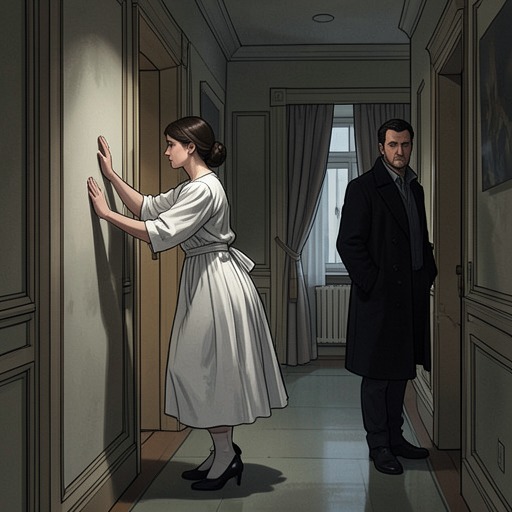
Bigger first encounters Mrs. Dalton in the hall while following a man through the house. She is an older, tall, thin white woman who walks silently, raising her hands to touch the walls on either side. Her grey eyes appear stony to him. Henry Dalton briefly takes her arm, and she confirms that she is all right before continuing down the hall. A large white cat follows close behind her. The scene gives Bigger a direct view of how she navigates: the walls provide orientation, and another person can offer brief physical guidance, but she proceeds through the house herself.
Henry Dalton then tells Bigger plainly that Mrs. Dalton is blind and has a deep interest in Black people. That description places her condition beside her social position and stated concern, without suggesting that the condition itself explains her attitudes. For Bigger, however, the first encounter is startling. He reads her pale appearance and silent approach through his own unease, and her inability to see him immediately becomes part of how he imagines the risks of serving in the household.
A House Navigated by Touch and Sound
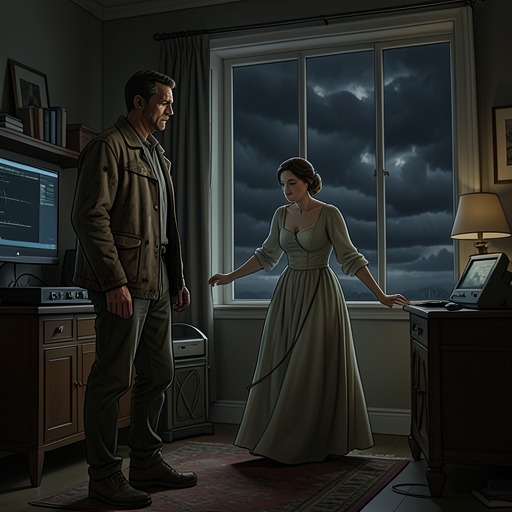
A later encounter in the kitchen shows that Mrs. Dalton’s blindness does not leave her unaware of her surroundings. Bigger comes downstairs for water and finds her standing still in the middle of the room. A clock ticks on the wall; the cat sits nearby. He hesitates at the door, then enters when she speaks to him. As he walks to the sink and fills a glass, he watches her, uneasy that she may somehow see him. In fact, she turns toward the sounds of his steps and the glass touching the sink. Her questions about his room are preceded by waiting for these sounds, not by sight.
The scene establishes an important contrast between visual access and other forms of awareness. Mrs. Dalton cannot see Bigger, but she listens closely enough to locate his movement. The narrative presents her as still and attentive, while Bigger experiences that attention as unsettling because he does not know what she can infer. His fear does not arise from her having seen him; it arises from the uncertainty of being observed by someone whose attention works differently from his own expectations.
Her movement elsewhere in the house reinforces that this is an ongoing practical reality, not a single dramatic entrance. After she gives Bigger the rest of the day off, he hears her shoes receding along the hall and stairs and imagines her feeling her way with her hands against the walls. He reflects that she must know the house extremely well. The established routines of the Dalton home thus make movement possible, while also making her reliance on familiar spaces visible to Bigger.
Mrs. Dalton and Bigger’s Concealment
The blindness becomes consequential during the aftermath of Mary Dalton’s death. Mrs. Dalton has been near Mary while Bigger is present, but she does not realize that Mary is dead. She assumes her daughter is drunk, a condition she has encountered before. Bigger understands that Mrs. Dalton did not know he was in the room either; he believes his presence as a Black servant would not have occurred to her as a possibility in that situation. Her inability to see is therefore part of the immediate circumstances in which he believes he can conceal what has happened.
When Mrs. Dalton later speaks with him, he notices her worry and understands that she might ask more about Mary. He assumes she will not want to discuss the family’s trouble with a poor Black servant. In his reading, their racial and class positions reinforce the concealment: she is wealthy and white, while he is poor and Black, and he expects that this divide will inhibit her from pressing him. She tells him that Mr. Dalton is unwell, that they will not be going out, and that Bigger may take the day off. Her decision is ordinary household business, but Bigger receives it as a chance to leave and visit Bessie. He is confident that the social distance between employer and worker, together with Mrs. Dalton’s failure to know what happened to Mary, has left him safe for the moment.
The episode does not establish that Mrs. Dalton deliberately protects Bigger or suspects the truth. Rather, he treats what she does not know as an opening. Her blindness is one element in a larger misrecognition: she mistakes Mary’s condition, while Bigger believes the household’s racial assumptions make him less visible as a possible source of danger. That belief helps him convert a moment of uncertainty into temporary confidence and action.
Literal and Social Blindness
At breakfast, Bigger generalizes from the events of the night. He thinks of Jan, Mary, Mr. Dalton, and Mrs. Dalton as blind in different ways, and concludes that people often fail to see what conflicts with what they want to believe. This is not a medical description of Mrs. Dalton. It is Bigger’s developing theory of how he can act unnoticed: those around him, he believes, see the familiar roles of servant, daughter, employer, and family member rather than the concealed crime. Mrs. Dalton’s literal blindness gives the metaphor a visible point of departure, but Bigger extends it to people who can physically see.
That extension offers him a false sense of security. He reasons that the household did not recognize Mary’s death or his presence, and that other people may likewise overlook what he has done. The thought temporarily steadies him after the killing, but it does not make the evidence disappear or ensure that his concealment will hold. In this way, the state connects the household scenes to the plot’s later exposure of his crime: Bigger’s interpretation of what others cannot see shapes his conduct, even as it overstates how securely he can control what they know.
The Limits of the Metaphor
The novel keeps Mrs. Dalton’s actual impairment distinct from Bigger’s figurative use of blindness, even as it links them. She moves through familiar rooms by touch and listens for footsteps and objects; those details give her condition a daily, material presence. Bigger, by contrast, turns blindness into a claim about racial and class relations, in which wealthy white people fail to recognize Black experience or imagine a Black servant as a possible actor in the events around them. The metaphor belongs to his effort to understand and exploit the household’s assumptions, not to a claim that visual impairment itself produces moral ignorance.
The contrast also makes the limits of his confidence legible. Mrs. Dalton can identify where Bigger is by sound, although she does not understand the meaning of his presence on the night Mary dies. In the later inquest, Bigger confronts another form of social misrecognition: Bessie Mears’s death is brought forward in connection with Mary’s case, while he believes that the white public will care far more about the death of a white woman than about a Black woman. The episode broadens the novel’s concern with who is noticed and whose suffering counts. Mrs. Dalton’s blindness is one sharply defined condition within that concern, while Bigger’s expansive metaphor exposes the racial hierarchy he believes governs attention, accusation, and justice.